The value of software in a Fable world
When more people can build software, what happens to the value of software?
With Fable + Claude Design, stuff I've been dreaming about for years can be prototyped and built in a day.
I talked about this on The Panel podcast yesterday:
Some of you will remember that back in 2018 I had this idea for Spots.fm:
Spots is a way to sponsor independent creators on their YouTube channels, newsletters, podcasts, etc.
Jon Buda (my Transistor co-founder) and I were thinking about building it, but we had to shelve it because we were still trying to get Transistor to profitability.
(The idea goes back even further: in 2012, I built a self-serve form for the Product People podcast to book and pay for ads on my site.)
So three days ago, I decided to start building it.
I've had the vision, shape, and functionality for Spots in my head for years. I started by creating some rough wireframes myself, uploading those to Claude Design, and having it build interactive mockups.
Then, I went to Claude Code (I've been using Aaron Francis' Soloterm.com as my "meta-harness"). I created a Product Requirements Document using Brian Casel's plugin, gave Fable that PRD + the design from Claude Design... and it went to work.
I recorded this demo three days ago, shortly after finishing the first build of the Ruby on Rails app:
It's incredibly exciting to see something you've thought about for years come to life before your eyes.
I want to see how far I can take this idea. So I wrote down my goals for the project:
My goals for the Spots.fm project:
Build a web app I can use myself. How does it feel to be the customer? What's it like to try to get sponsors this way?
Use it in public: show it off, demo it, make videos about it.
Send organic demand to a waiting list. When people are interested, funnel them to the spots.fm email list.
Get a few initial users: gradually invite folks I trust to try it themselves.
Over time, I want to see:
Is there enough customer demand for this? How many people are already searching for this? How easy is it to get folks to sign up?
Is there a business model that makes sense? Can the pricing and volume actually produce enough revenue?
Is this an industry/category I want to be in? Is there founder/market fit?
I don't want to get ahead of myself. 99% of the time, even good ideas can't work for a variety of reasons (lack of founder/market fit, unable to get distribution, etc).
If the answers are positive, I think Jon Buda and I will talk about building an actual production-ready application.
What's the value of software now?
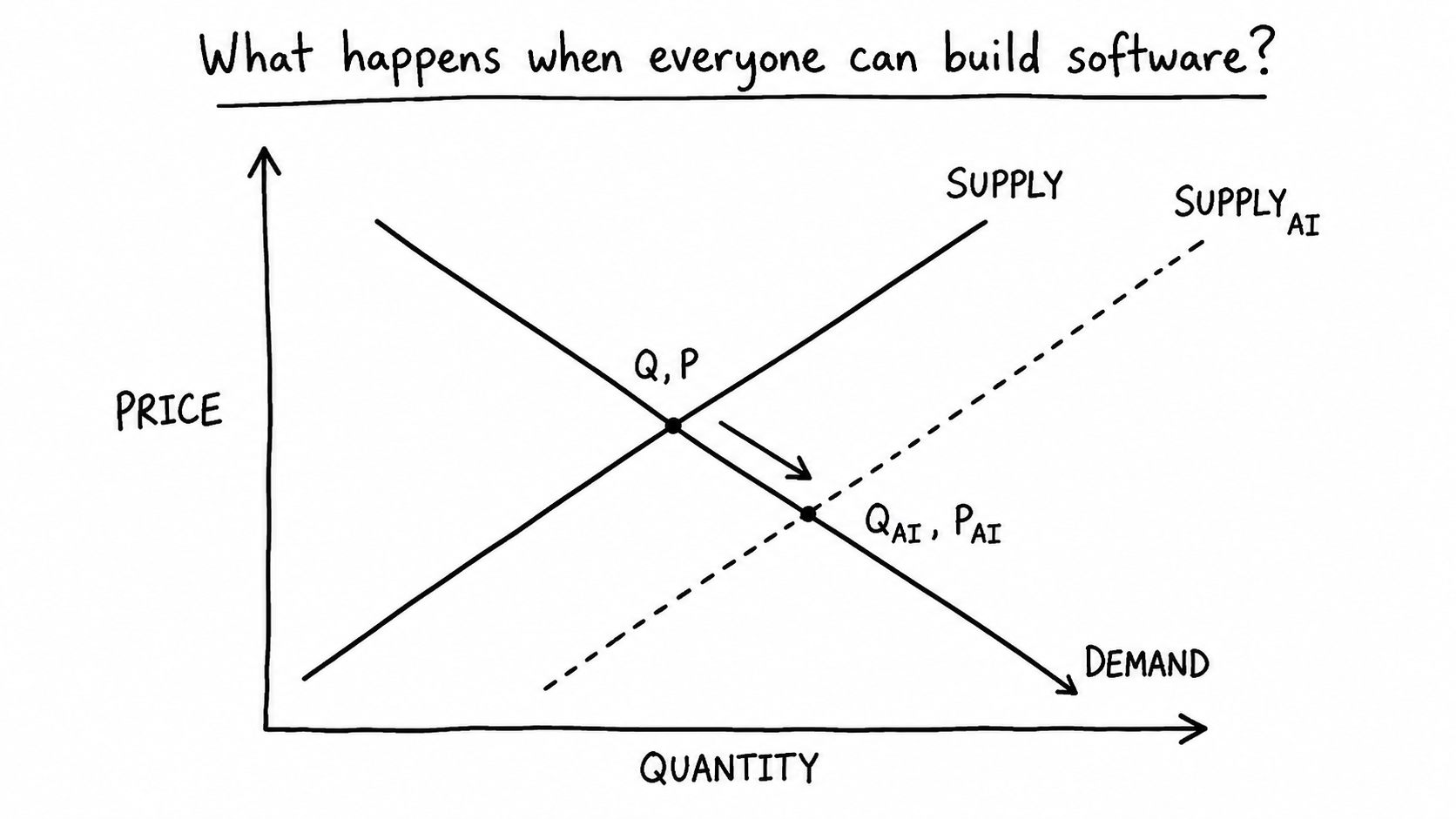
But until then, we're in a whole new era of building products. The dynamics have changed. And it raises a bigger question I can't stop thinking about.
In economics, when you increase the supply of something, its market value goes down (and so does the price).
Up until now, software was valuable because it was hard to make. You needed a team of engineers, money, and time.
I remember in the early days of the iOS App Store, you could sell a fart app and make a lot of money. But once everyone was making fart apps, nobody could make money on them. When fart apps were no longer scarce, their value to the market dropped.
Generally, the economy rewards difficulty and rarity. If something is hard to do or make, you get to charge more.
So if AI reduces the time it takes to build software, what happens to the value of software?
Looking at different Slacks I'm in, so many people I know are building new apps. With this much software flooding the market, do any of us have a chance anymore? (I mean, it was hard to build a profitable software company before AI; now it feels even harder!)
My guess is that people will still want to buy certain types of software and tools "off-the-shelf."
The software products that succeed will need to have:
Distribution. Can you actually get people to find the thing?
Taste. Do you know what to build, and what to leave out?
Trust. Why should people trust you and your brand?
Founder/market fit. Do you have passion and advantages in this market?
Indie entrepreneurs need to stack every advantage they have, and increasingly "coding" won't be the advantage it once was.
Which is why I'm not really asking whether I can build Spots. Of course I can. I built it in a weekend.
The questions that actually matter are the ones I wrote down at the start: is there demand, is there a business model, is this a category I want to be in?
Cheers,
Justin Jackson
PS: Interested in making it easy for businesses to buy ads on your podcast, YouTube channel, newsletter, or blog? Sign up for the Spots waiting list.
Are you a business that wants to buy ads on podcasts, YouTube, et? Sign up for the Spots waiting list!
Connect with me on:
🦋 Bluesky
💼 LinkedIn
🐘 Mastodon
🧵 Threads