Do the hardest thing
Last week, I was walking to a coffee shop on Bloor Street in Toronto, listening to the Mostly Technical podcast. Aaron Francis was interviewing Jesse Hanley, the founder of Bento.
Aaron asked about something Jesse had told him after he'd been let go from his full-time job:
"I was talking about some ancillary services I could do. And you said: "No, no. Do the hardest thing!" Where does that philosophy come from?"
In Jesse's mind, there isn't much competition in the hard things, because most people don't want to do them. As he put it, you're better off choosing the hardest thing possible when few others are willing to attempt it, and sticking with it until it pays off.
I love the shape of this advice. Ruben Gamez once told me something in the same spirit, back when I was spreading myself across a pile of small projects. He told me to be more deliberate about the business I chose to build. A lot of people don't choose ambitious projects because they're hard in ways they don't like, so they retreat to (lower value) projects that feel easier.
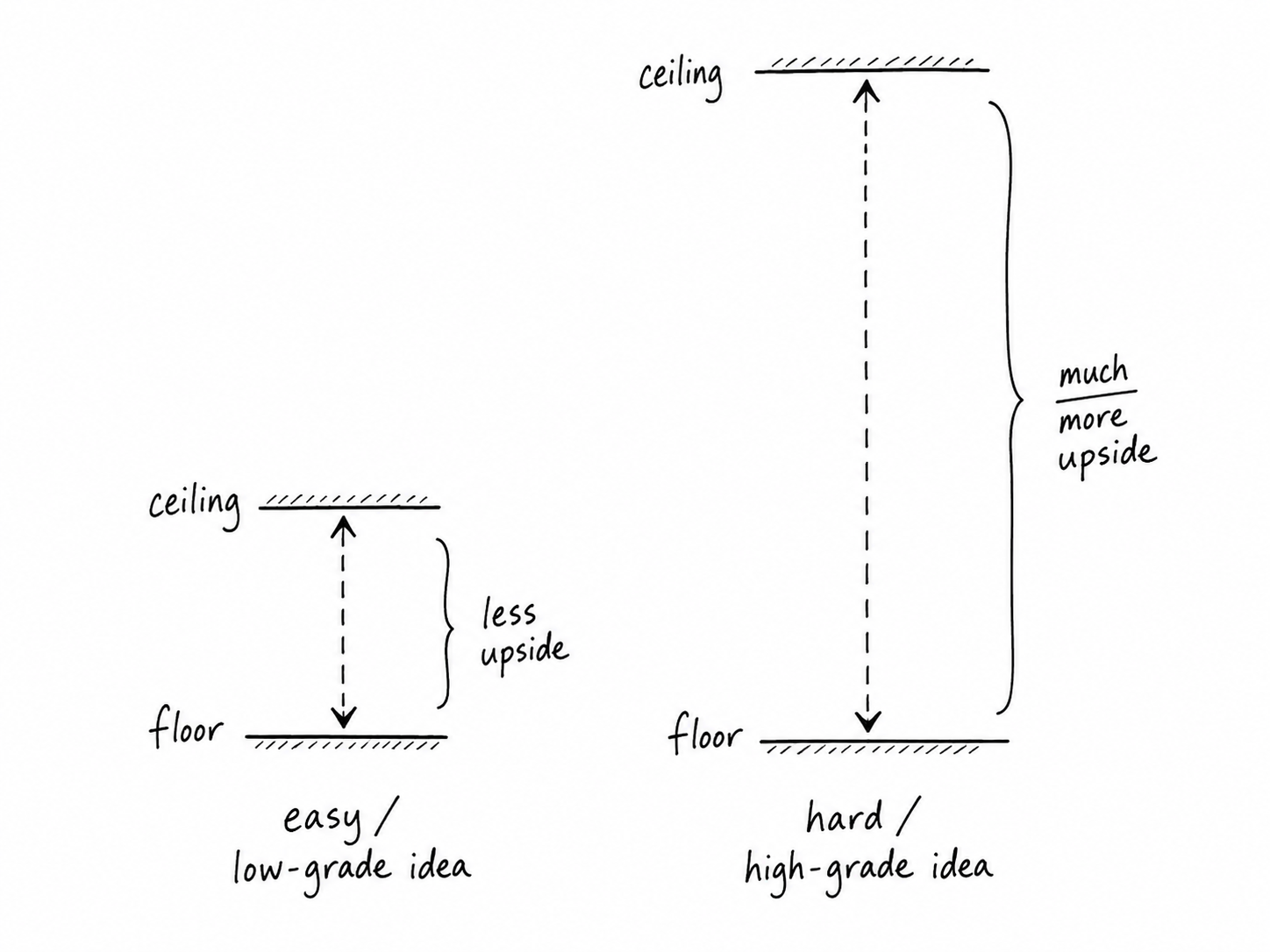
For me, "working on the hardest thing" meant I had to stop limiting myself to projects that I could do solo. I had to think bigger and work on a more challenging category. This eventually led me to partner with Jon Buda to work on Transistor. Podcast hosting was a harder challenge to get from 0 to 1 than other projects I'd pursued, but it had much more upside.
Jesse Hanley had a similar experience with Bento:
"It's been over seven years since I started working on Bento. Not many people are willing to grind on something for that long. Finding product-market fit often means doing the hard things. And so you are better off choosing the hardest thing possible, when not many other people are willing to do it, and just stick with it until it pays off. It just does take time. It does take effort. And so I feel like it's better to push towards 'the big thing' than 'the small thing.'"
Working on "the hardest thing" doesn’t mean “working on the thing that makes you work the hardest.”
In 2003, I opened a snowboard shop. I worked harder in those years than at almost any time since. Retail is a grind! You have to deal with inventory logistics, theft, employee scheduling, and maintaining a high stock turnover rate. By 2006, the shop was closed, and I was in debt.
The same year I opened my shop, two co-founders launched Skype. Three years later, they sold to eBay, and each pocketed about $350 million.
What separated the Skype founders and me was the problem space we chose to work on.
When I was running the shop, I was working harder than ever, but I wasn't working on "the hardest thing." Lots of people choose to start a retail shop.
Letting people make free calls over the internet was a genuinely hard thing to build. Because of that, few people tried. And it turns out it was also valuable to build.
Your hardest idea is often your best idea, the one with the most potential. Venture capitalists call this the power law: a fund's single best investment usually returns more than every other investment put together. Your own ideas follow the same curve: your best (hardest) idea is likely worth more than your second- and third-best ideas combined.
After I'd shared a draft of this article, a reader named Emmett wrote back:
"This idea hits hard for me.... Now, I just need to figure out what "the hardest thing" for me is."
Doing "the hard thing" means pursuing the highest-value problem you can find that still sits inside your zone of expertise; the hardest problem you're personally in a position to win. Usually, that's a problem space most people won't touch, in a market where the demand already exists.
Look at the durable startups: Stripe, WP Engine, Bento, Shopify. Each tackled a "hard thing" in a market hungry for a better solution. They had to do things that most people wouldn't, and that's why they're still standing.
Jason Cohen describes the whole approach in two sentences:
"Find a good idea that's actually worth doing. Get obsessed and stay obsessed."
Every company is hard to build, so you might as well push yourself to do the hard thing. My snowboard shop was a hard job attached to an easy idea. With Transistor, the underlying problem (podcast hosting) was hard enough that most people wouldn't touch it. That's the difference that paid off.
Cheers,
Justin Jackson
PS: Like all business advice, this advice is necessary but not sufficient for success.