Claude Code and the new age of software development
The first month of 2026 has been a blur.
Like many of you, I've fallen down a Claude Code rabbit hole. Whenever I have spare time, I'm experimenting with it.
As many others have said, Claude's Opus 4.5 model was a tectonic shift for the software development world. When folks started playing with it over the Christmas holiday, many of us had the same realization: "Holy shit – you can build serious software just by chatting with Claude Code in the terminal."
I felt like I've had a front-row seat to this evolution because of my friendship with Brian Casel, who has long forecasted that AI would fundamentally change how we build products. In our podcast, we've ended up discussing LLMs in nearly every episode.
Building with AI
Since the beginning of the year, I've focused more of my time on building with AI.
First, using Cursor, I built a new website for Marketing for Developers (a private community I'm launching).
But soon after, I started using Claude Code exclusively, and I've been building up a storm.
One thing I'm doing is exploring features we're considering for Transistor, but built as a standalone app.
Here's a demo of a video podcasting app I built completely with Opus 4.5:
All of this exploration reminds me of an old FreshBooks story...
The FreshBooks story
Back in 2013, CEO Mike McDerment knew FreshBooks needed a complete rewrite, but he was worried about taking such a big risk with an established app. Instead, he decided to do it undercover. His team secretly built a new product called "BillSpring" and launched it as a free, standalone app.
“What if we created a new company and competed with ourselves?” A new company could have its own name, brand, logo, website, articles of incorporation, user agreement, service staff – “We could use that to figure out if we could build a product that’s truly better than the one we were offering.”
The secrecy gave them permission to take big risks without existing customers watching every move. Nine months later, a FreshBooks user called to cancel his account: "I'm switching to this great new company, BillSpring." That was the affirmation McDerment needed to know they'd built something better. They eventually folded the "BillSpring" app and made it the new "version" of FreshBooks.
This is the advantage I'm seeing in building prototypes with Claude Code: you can take risks, try weird things, and discover what the product actually needs to be – before committing to building it into your main platform. Even more salient: what took FreshBooks two years and a full engineering team, I can now explore in a weekend with Claude Code.
As a builder and product person, I'm having more fun right now than I've had in years. Being able to articulate a clear vision and architecture, and have Claude Code build it, is incredibly satisfying.
This mirrors what I'm seeing from a lot of my peers:
Marketing in the Age of AI
A side project I'm working on in 2026 is Marketing for Developers.
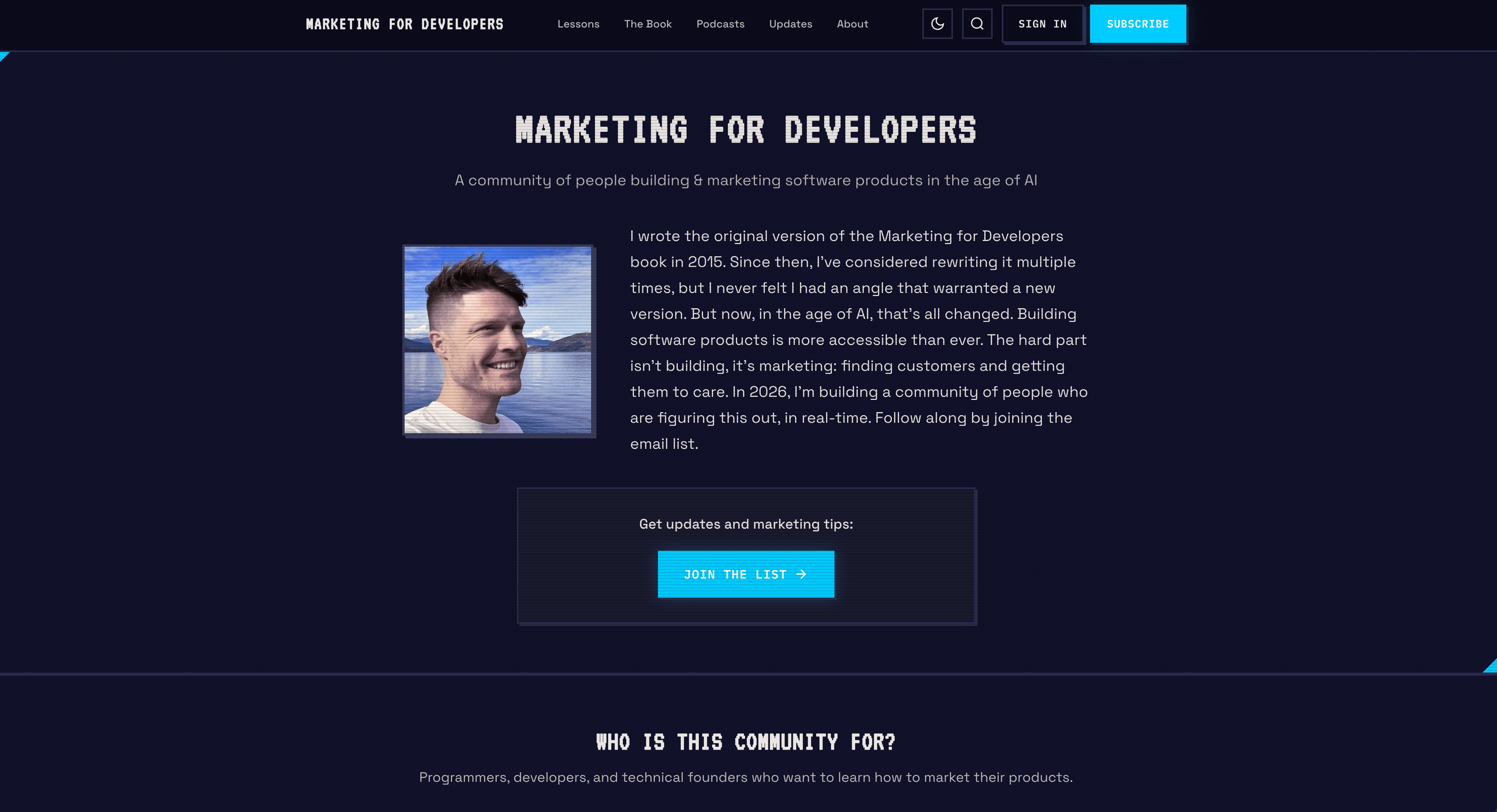
I wrote the original book in 2015, and that launch changed my life.
Since then, I've considered rewriting it multiple times, but I never felt I had an angle that warranted a new version. But now, in the age of AI, that's all changed. Building software products is more accessible than ever. The hard part isn't building, it's marketing: finding customers and getting them to care.
Originally, I thought I might rewrite the entire book this year.
But as I started, I realized a book would be too slow to capture how fast things are moving right now.
At the same time, a few people joined the M4Devs paid membership (before I'd even officially launched it). As I started sharing tips and tactics in our private Discord, I realized that the right "shape" for learning and advice these days is in communities, where you can discuss what's happening right now.
So, I'm
Making the original 2015 book free online
Focusing on the community: publishing podcast episodes, lessons, videos, and discussions for members.
If you want, you can join M4devs as a free (or paid) member here.
How are you feeling in all of this?
When I talk to folks in tech, some people are hyped on all this AI stuff, others are apprehensive about it.
What's clear, though, is that everyone is feeling the pressure.
The pressure to stay on top of this giant tsunami of change.
The pressure to not get left behind.
The pressure to build more, have more agents going simultaneously, and not waste any time or cycles.
I feel it too.
But I keep coming back to this idea that most often, we don't create the waves, we ride them.